


There’s a particular kind of silence that settles over a house when everyone inside senses you’re in a mood. No one would dare name it. The dishwasher still hums. A cabinet closes more gently than usual. The kids disperse. Someone begins a sentence and then decides not to finish it. Nothing dramatic has happened, and no one’s raised a voice. But the air has tightened, and at the center of it is a woman who would describe herself, accurately, as calm.
She’s not yelling or cruel. She’s just compressed. Very compressed. I know this woman because I am her.

For most of my adult life I’ve thought of myself as two parts:
There’s the porcupine. Alert and competent, always scanning for risk, always bracing before fully relaxing. She built the company, managed the team, anticipated problems before they bloomed, and kept systems from collapsing. She’s disciplined and sharp and strategic, and she’s kept a lot of things alive that wouldn’t have made it otherwise.
And then there’s the strawberry center. Sweet, soft, earnest. She wants warmth more than control, and bruises faster than a peach when a tone shifts. She feels the tween’s withdrawal as a small grief. She carries other people’s losses — some from people she’s never even met — in her body. She wants the real conversation, not the efficient one.
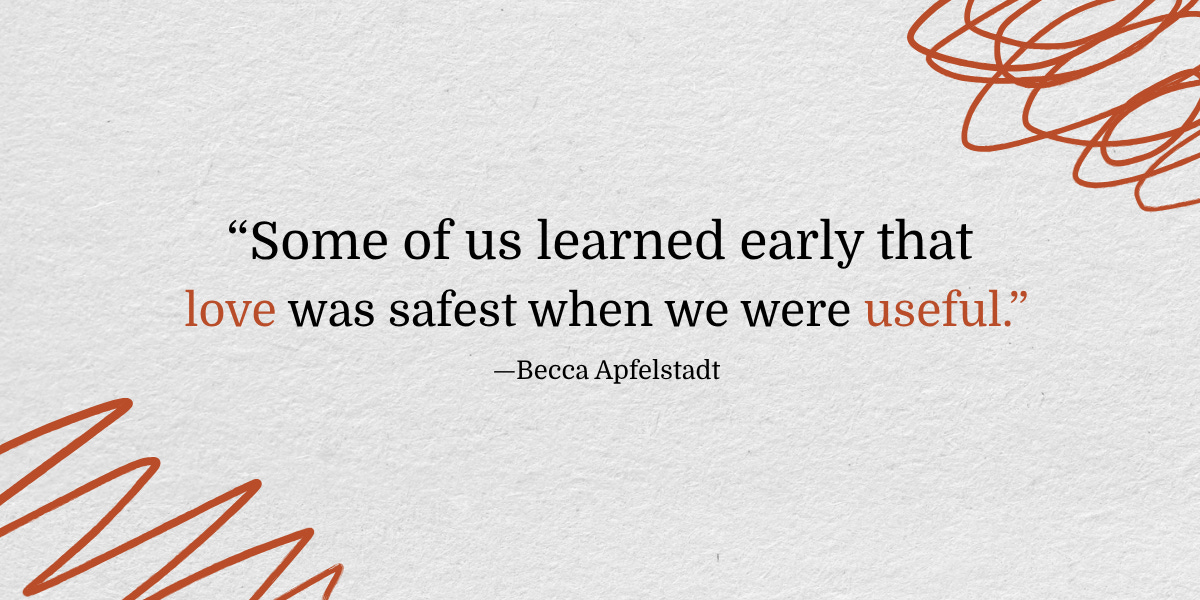
Success rewards the porcupine while marriage and motherhood expose the strawberry. Some of us learned early that love was safest when we were useful.
When you’re the person holding most of the responsibility in a room — whether that room is a boardroom or a kitchen island — it’s easy to justify the quills. You call it leadership, or clarity. You might call it standards and suggest smugly that others should find some. And sometimes it’s all of those things. But other times, it’s raw fear dressed up in a blazer and heels with a name tag that says Hello, my name is Competence.
It’s the fear that if you soften, something will absolutely fall apart. (You’re supposed to be punished for softening, remember?) The fear that if you stop anticipating, no one else will step in — no one could possibly. The fear that you’ll slowly become invisible in your own life.
So you grip. I know I do. You might correct someone quickly. Or shorten a conversation. Or solve the problem before they’ve finished explaining it. From the outside it looks like solid strength and high capacity. Inside the room, the oxygen thins.
Your son edits his story before telling it. Your husband abandons his sentence mid-thought based on the size of your pupils. Your team member brings you the polished version instead of the honest one. The structure stays standing. Everything living inside it starts to shrink.
Holding is different. And it’s so much better.
For a long time I believed my vigilance was what made everything work. And it did, for years. But vigilance exhausted me quickly. I got really good at protecting what I’d built, and not nearly as good at enjoying it. That’s one of the hidden costs of success: the very instincts that helped you get here eventually turn on you.

Not long ago, I felt that familiar compression rising at the dinner table. The day had been full of decisions and the kind of small arguments you only have with yourself. By evening I was efficient and distant. One of my kids started telling a long, meandering story at a pace I was struggling to tolerate. It collided with the to-do list running through my head.
I had the instinct to tighten it. To summarize it for her. To improve it so it would move faster, cleaner. We didn’t have all night. There were dishes to finish, messages to answer, and the unfinished day waiting in the next room. I could feel the urge to speed the whole thing up so my brain had less to carry.
Instead, I noticed the drift, and chose not to get pulled toward it. I looked at her freckles. I softened. I let her finish and leaned in.
It took longer than the porcupine-under-pressure would prefer, but nothing collapsed. The dishwasher kept humming. The world didn’t punish us for the extra minutes.
And something shifted in the space I chose not to manage. She kept going, and the story unfolded in ways I’d have missed if I’d tightened it. The room didn’t close around my efficiency. It opened. And in that small opening, she felt safe enough to keep going. She settled. She brightened. By the end, my baby girl was glowing inside her own story — tossing out one-liners, delighting in her own wit, fully at home in the room and in my presence.
I’ve noticed that holding often feels inefficient in the moment. It feels slower, less optimized. It can’t possibly provide the immediate relief of control. It’s not designed to. But it builds something gripping never can: safety.

In business, in marriage, in parenting — real power is rarely about getting sharper. It’s about learning when sharpness isn’t what the moment needs. There are moments that demand an edge, or clarity, or fierce protection. But there are other moments — many more — that demand steadiness without any of those defenses.
The porcupine doesn’t have to disappear. She just learns she doesn’t need to flare up every time. And the strawberry doesn’t have to dissolve into something unrecognizable. She learns that being marked isn’t the same as being ruined. Both live in the same body, the same life. And if you’re willing to let them, they can learn to work together instead of fighting for control.
A lot of us built our lives by bracing. It made us dependable, decisive, competent under pressure. It helped us survive imperfect childhoods, build companies, run households, solve problems before they surfaced. But when the bracing never eases, the people closest to us feel the edges first. They get the authority, the efficiency, the structure — but not always the warmth that made those qualities trustworthy in the first place.
Grip is the strength most of us were taught. Holding is the other one — quieter, harder to recognize, the kind that feels the pressure gathering and chooses to release it before the room has to. Before the strawberry bursts.
Because the people we love shouldn’t have to brace for us.
— Becca
